
1. Biography and Death Overview
Zorer was born in New Albany, Indiana in 1951. He turned professional in 1973 and quickly established himself on the PGA Tour. In November 2025, the PGA Tour confirmed his death at the age of 74. The cause of death was not officially disclosed, only confirmed by notification from long-term tournament organizers and family.
During his nearly 50-year professional career, he won 10 PGA Tour victories and later numerous titles on the Champions Tour, including the 2002 Senior PGA Championship. Unlike many players whose names only exist in statistics, he was one of the few players remembered by fans as “Fuzzy” due to his outgoing, humorous, and fast-paced playing style.
2. Two Majors: Augusta and Winterford
Zoler’s peak achievements are concentrated in two major championships: the 1979 Masters and the 1984 U.S. Open.
- At Augusta in 1979, he made his Masters debut and reached a playoff against Ed Snead and Tom Watson, both of whom collapsed on the last three holes. On the second playoff hole, he hit a precise approach shot, stopping the ball near the hole, and then sank a birdie putt to win the green jacket, becoming one of the very few players to win a Masters debut.
- In 1984, he also won the U.S. Open at Winterford through a playoff: mistakenly believing Greg Norman had taken the lead on the final hole, he raised the white towel in a gesture of surrender, only to find that Norman had only parred. The following day, in an 18-hole playoff, he won by a decisive eight strokes to claim his second major, making that white towel a classic image in tournament history.
Beyond his two major championships, he repeatedly made crucial shots under immense pressure during regular PGA Tour events, making “not shaking under pressure” a hallmark of his playing style. It was this ability to win playoffs while also joking in front of the camera that shaped his early image as “one of the most sociable and humorous champions.”
3. The 1997 Masters: A Single Sentence Leads to a Dramatic Turn
However, if his early victories cemented his place in golf history, a single “joke” in 1997 cemented his place in another, more indelible memory. At the time, 21-year-old Tiger Woods was sweeping Augusta with unprecedented dominance, poised to win his first green jacket and usher in a new era for the sport.
On the eve of Woods’ victory, Zoller, during a television interview near the clubhouse, jokingly made a racially stereotypical comment about the champion’s dinner menu, then added an even more scathing remark as he turned to leave. These remarks quickly sparked a backlash: in a movement long criticized for its exclusivity and historically restrictive treatment of people of color, such “jokes” were no longer seen as sideline banter, but rather as a direct clash with the demands of the entire era.
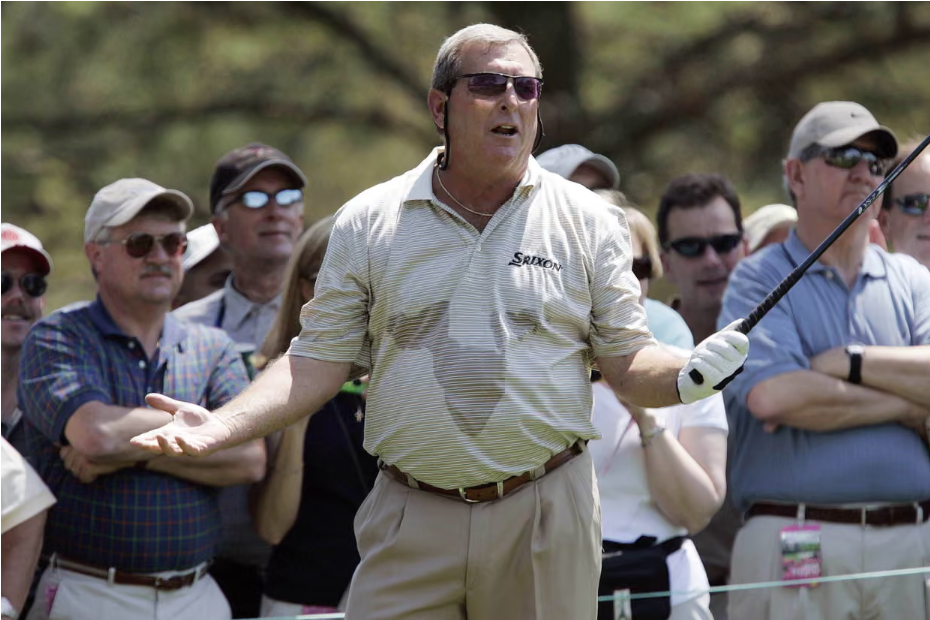
Afterwards, Zoller publicly apologized, repeatedly emphasizing that he meant no harm and underestimated the potential damage his words could cause, but the consequences were irreversible. Several sponsors terminated their partnerships, and he mentioned receiving death threats in interviews, writing years later that it was “the worst thing that ever happened to me.” Those few words from 1997 ultimately became a dividing line: before that, he was known as a joking, self-deprecating “fuzzy” person; after that, the words “racist joke” were inextricably linked to his name.
4. Later Years and Beyond the Course: Honors, Family, and Retirement
From a competitive standpoint, Zoller transitioned to the Champions Tour after the age of 50, continuing to win as a veteran, including the 2002 Senior PGA Championship and an opening tournament in 2004, adding a seasoned finishing touch to his career. He also received the USGA’s Bobby Jones Sportsmanship Award, recognized for his humor, courtesy, and love for the sport on the course.
In his personal life, he resided in Indiana for many years, running a eponymous liquor and related business ventures. His wife, Diane, passed away in 2021, leaving behind several children and grandchildren. Following his death, colleagues and organizations published tributes, recalling his highlights at Augusta and Winterford, while acknowledging his life as “complex” and “lesson-filled,” reminding people, beyond his illustrious achievements, that words and attitudes can instantly reshape a person’s public image.
5. A Complex Legacy: More Than Just Achievements
In a sense, Zoller’s life spanned the turning point of golf’s transition from a “club tradition” to a globalized and diversified sport. In his early years, he symbolized a more relaxed and uninhibited tour style: fast-paced play, laughter on the go, interaction with the audience, and a willingness to joke even under the pressure of major tournaments. However, by the late 1990s, especially after Tiger Woods changed the sport’s audience structure and cultural context, certain aspects of his personality that had been tolerated or even considered “old-school humor” suddenly became objects of scrutiny and criticism.
When he passed away, it was difficult for people to focus solely on his two trophies or the white towel, or even just on a particular interview clip. A more apt description might be: he was a champion who hit brilliant shots at crucial moments, and also someone who failed to retract the old narrative in time when public opinion was rapidly changing—he enjoyed the tolerance of the traditional era, but also bore the backlash of the new standards.
For the world of golf, he left behind not just a simple label of “good guy” or “bad guy,” but a story with a reminder: results can send a person into history, but words and deeds will determine how people are willing to turn the page.